Opens in a new tab

English Basic Modal Verbs

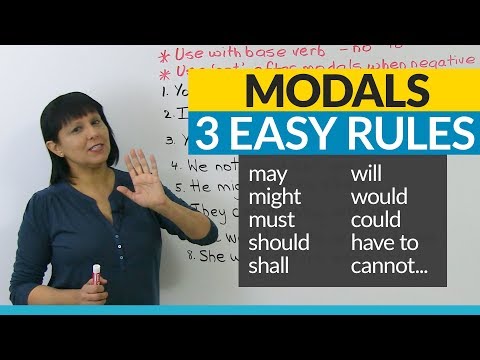
Modal verbs (can, could, may, might, must, should) go before a base verb and never take -s: She can drive. Have to and need to do change: He has to leave.

  • CEFR A2
  • 8-question quiz
  • 2 exercises
  • Audio lesson
He / she / it form
  1. can→she canno -s
  2. must→she mustno -s
  3. should→she shouldno -s
  4. have to→she has tohave → has
  5. need to→she needs toadd -s
  6. have to (past)→she had topast of have to and must

Listen to the lesson

Modal verbs and modal auxiliary verbs are verbs that are typically used in combination with another verb in the infinitive.
A modal verb typically follows the same conjugation for all personal pronouns, and does not have the third-person-s.
The most common modal verbs are: can, could, may, might, shall, should, would, ought to, must, will, used to. 

Other modals and modal auxiliaries do have the third-person-s when conjugated. Examples are: need, have to.

May – Might – is used to signify a possibility

CORE Languages English Basic Modal Verbs

Examples:
I might go skateboarding. He/She might go skateboarding.
We may join you tomorrow. He/She may join you tomorrow.
They might be late. He/She might be late.

Can – Could – is used to signify the ability or the possibility

CORE Languages English Basic Modal Verbs

Examples: 

I can read.
He can speak three languages.
We could go out tomorrow.
She could not find her purse.

Must & Must not  

I must (do something) = I need to do something/I am expected to do something. 
I mustn’t/must not do something =  I am not allowed to/shouldn’t do something, it is the wrong thing to do. 

The modal verb “must” is typically used with another verb in the infinitive, omitting the infinitive marker “to”.

Examples: 
I must (modal verb) call (verb in the infinitive) my friend.
You must (modal verb) be (verb in the infinitive) very tired!
She must call the doctor. He must take the train.

You mustn’t (must not – modal) be (inf.) so hard on yourself! (You should not be so hard on yourself)
You mustn’t (modal) tell (inf)  anyone about this! (def: You are not allowed to tell anyone about this!)

Have to

The modal auxiliary verb “to have to” signifies something similar to “must”, and is commonly used when someone needs to or is expected to do something. Unlike “must“, “have to” can be used in the past, simply by using “had to“. There is no past-form of “must”. When conjugated, “have” changes to “has” in the third person singular.

Examples:
I have to get up early tomorrow. She has to get up early tomorrow.
I had to get up early for my flight last week.
You have to be very careful. He has to be very careful.
She had to cancel her appointment last Friday.

To use “have to” in the negative, we need to use “to do”.
I don’t have to get up early tomorrow. She doesn’t have to get up early tomorrow.

Need to  

The modal verb “need to” is used to signify that something is important, but not absolutely necessary (for which we would use “must” or “have to”). Just as “have to”, “need to” can be used in the past, using “needed to”. We need to add an “s” for the third person singular.

Examples: 
I need to go to bed soon! (It is not an obligation, but it is strongly needed) She needs to go to bed soon.
We need to buy eggs at the store. He needs to buy eggs at the store.

They needed to send the answer by noon yesterday.
I needed to buy flour and milk for the recipe.

Should 

“Should” is used to signify that it would be appropriate, or suggested to do something, but it is not a necessity or an obligation. The modal verb “should” is used with another verb in the infinitive, but without the infinitive marker “to”. There is no third-person-s.

Examples:
I should call my parents more often.
He should eat more vegetables.
We should go to the concert next Friday.
They should offer vegetarian options on the menu!

Like “Must”, there is no past tense form of “should”. However, it is possible to use “should” in the past, by using it in combination with the Past Participle.

I should have called my parents more often.
You should have eaten more vegetables.
We should have gone to the concert last Friday.
They should have offered vegetarian options on the menu!

Key vocabulary

WordMeaningExample
can / can'tability or possibility / no abilityI can't open this file. Can you send it again?
couldpast ability; a polite request; a possibilityCould you call me back after lunch?
may / mightsomething is possible, but not sureIt might rain, so we may move the event inside.
musta strong obligation or a ruleAll visitors must sign in at the front desk.
mustn't (must not)it is not allowedYou mustn't share your password with anyone.
have to / has toit is necessary; often a rule from outsideShe has to finish the report by Friday.
don't have toit is not necessary (but you can)You don't have to wear a suit on Fridays.
need toit is important or necessaryWe need to order more paper for the printer.
shouldadvice; a good ideaYou should ask HR about your vacation days.
should have + past participleadvice about the past; regretI should have saved the document.

Practice: English Basic Modal Verbs

Work through the exercises, then test yourself with the quiz. Learn from your mistakes and try again as often as you like.

Exercises

Choose the modal verb

Complete the sentence with the correct form of the verb in brackets.

  1. She ______ speak three languages. (can)

    ability; no -s

    Show answer

    can

  2. He ______ work late tonight. (have to)

    he + have to

    Show answer

    has to

  3. You ______ smoke in the building. It's against the rules. (must not)

    it is not allowed

    Show answer

    mustn't

  4. My manager ______ approve the budget. (need to)

    he/she + need to

    Show answer

    needs to

  5. I ______ get up early yesterday. (have to, past)

    past of have to

    Show answer

    had to

  6. We ______ join you later. We're not sure yet. (might)

    possibility

    Show answer

    might

  7. You look tired. You ______ take a break. (should)

    advice

    Show answer

    should

  8. She ______ come in on Saturday. It's optional. (not / have to)

    not necessary

    Show answer

    doesn't have to

  9. I ______ find my keys this morning. (could, negative)

    past ability

    Show answer

    couldn't

  10. We ______ booked the hotel earlier. Now it's full. (should)

    regret about the past

    Show answer

    should have

Find and fix the mistake

Each sentence has one mistake. Write the correct sentence.

  1. He cans swim very well.

    modals have no -s

    Show answer

    He can swim very well.

  2. You must to call the doctor.

    no to after must

    Show answer

    You must call the doctor.

  3. She have to leave at five.

    she + has

    Show answer

    She has to leave at five.

  4. We should went to the concert last week.

    should have + past participle

    Show answer

    We should have gone to the concert last week.

  5. He don't have to work tomorrow.

    he + doesn't

    Show answer

    He doesn't have to work tomorrow.

  6. They musted leave early yesterday.

    must has no past form

    Show answer

    They had to leave early yesterday.

Quiz: 8 questions

1. Which sentence is correct?
2. He ______ get up early tomorrow for his flight.
3. Which sentence talks about the past?
4. "You mustn't tell anyone." What does this mean?
5. "You don't have to come to the meeting." What does this mean?
6. Your colleague has a bad cough. What do you say?
7. We ______ be late. The traffic is bad, but we're not sure.
8. I didn't study, and I failed the test. I ______ studied.

Not sure which level you are?

Take a free placement test and get your CEFR level, then start with the topics that fit it.

Find your level